


Modular Signage: Making Spatial Wayfinding More Flexible
 Aug 19, 2026|
 View:106
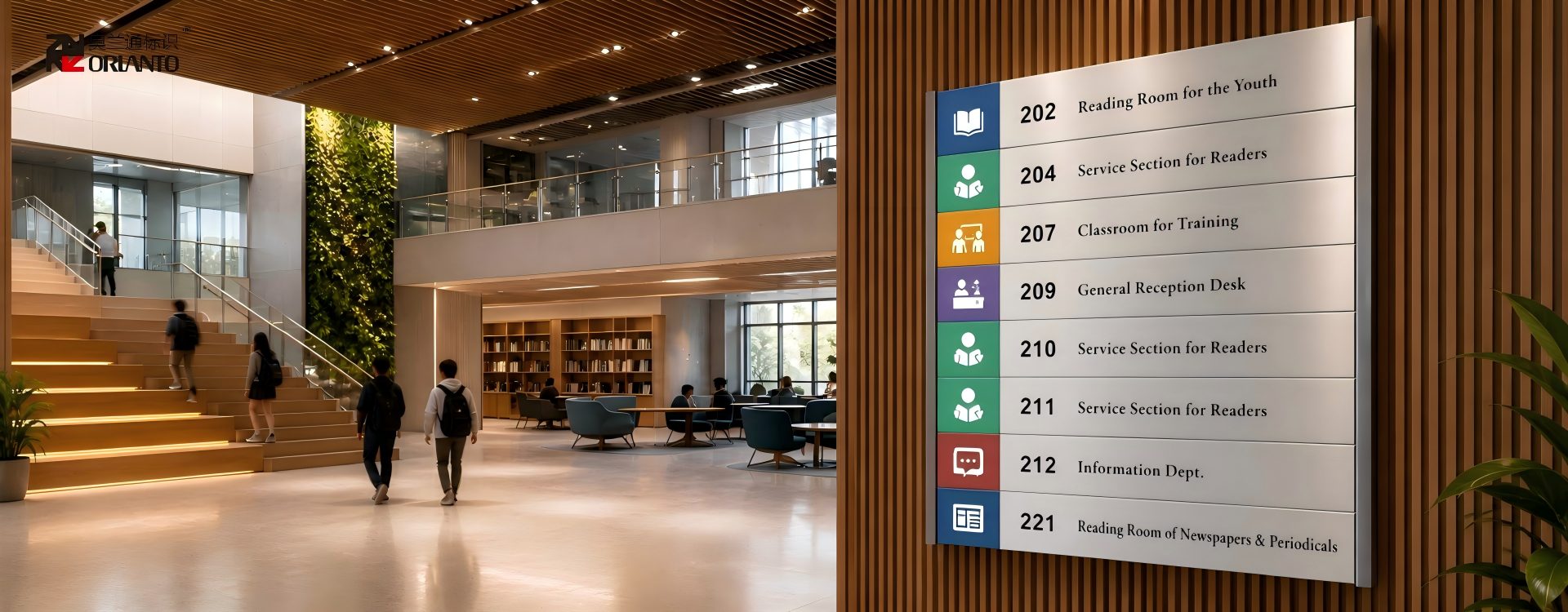 Walk into a modern building and you might notice something interesting: the floor directories, office door plates, and restroom signs all share a consistent style, yet each one seems to be independently replaceable. This is no coincidence – it is a design method that is reshaping spatial experiences: modular signage.
1. What is Modular Signage?
Modular signage is a design approach that breaks a signage system into independent, reusable, and combinable “modules” that are assembled through standardised interfaces. Its core idea can be summed up in six words: break apart, combine seamlessly.
A typical modular signage system consists of two layers:
Permanent layer: The aluminium profile frame fixed to the wall or ceiling, providing structural support.
Replaceable layer: The panel that carries specific information – text, graphics, directional arrows – which can be detached and swapped out as needed.
This “frame + panel” structure gives signage systems unprecedented flexibility. As Kim Pedersen, Managing Director of Modulex, puts it: “If the use of a building or parts of it changes, you can quickly update the signage. That is the essence of a modular signage system – you can remove individual parts, change panels, and ensure the signage remains relevant.”
2. Why is Modular Signage Becoming Mainstream?
① Flexibility to Handle Change
Traditional signage is often a one‑off investment – once the information becomes outdated, the entire sign must be removed and rebuilt. Modular signage is completely different. When offices are relocated, departments are reorganised, or branding is updated, you only need to replace the information panels; the frame structure stays untouched. For spaces that undergo frequent adjustments – hospitals, universities, airports, corporate campuses – this “tweak rather than tear‑down” capability translates into massive efficiency gains.
② Sustainability and Environmental Friendliness
The environmental benefits of modular signage are gaining recognition across industries. According to observations from the European Sign Expo, the signage industry is shifting towards sustainable practices, and modular signage systems are becoming increasingly common. Aluminium, one of the most recycled materials globally, further enhances the sustainability of modular signage. As demonstrated by the V&A East museum project – which used a modular system of 1,240 individual ceramic tiles – the design team nearly eliminated the single‑use plastic vinyl signage that is rampant in traditional museums.
③ Long‑Term Cost Effectiveness
Although the initial investment for modular signage may be comparable to or slightly higher than traditional systems, the long‑term savings are substantial. Updates require minor adjustments rather than complete replacements, significantly reducing reprinting and manufacturing costs, labour for dismantling and installation, and business disruption. This is an investment logic of “pay once, benefit for years.”
④ Real‑World Constraints
It is worth noting that modular signage is not a universal cure‑all. The value of the entire system depends on proper standardisation planning at the outset – if the dimensions and interfaces are not unified early on, replacement difficulties will still arise later. Additionally, components such as clips and magnetic attachments may experience wear and ageing over time, which should be factored into ongoing maintenance considerations. Understanding these constraints helps in making more informed decisions during the project planning phase.
3. Core Application Scenarios for Modular Signage
Modular physical wayfinding signs are widely deployed in various public buildings, primarily addressing the need for frequently updated room plates, floor directories, and directional signs.
Public Wayfinding and Spatial Signage
In public spaces, the value of modular signage is particularly prominent. The Songshan Lake Science Park wayfinding system, centred on “Nature + Science + Art,” uses creative design elements such as “scientific notebooks” and a “periodic table” format to express the infinite combinations of technology and resources through modular forms. The Shenzhen Talent Park wayfinding system also adopts modular design to flexibly accommodate information updates and maintenance needs.
The Design Research Institute (DRI) at Chiba University in Japan takes modularity to the extreme – permanent signage is used in public areas, while the studio area employs a modular display system with a grid structure that simultaneously holds both permanent panels and temporary event announcements. One system, two modes of use, switched with ease.
Extended Reading: Modular Thinking in Other Fields
Beyond physical signage, the modular design approach has also extended into other domains. In branding, award‑winning projects like Layher’s Red Dot brand identity and Grafana’s geometric block visual system (developed with HEX studio) both rely on modular grids to build their entire brand language. In the smart city arena, the City Code system assigns unique digital codes to urban infrastructure, bridging online and offline management. These are conceptual extensions of modularity in graphic and digital realms, distinct from the physical aluminium profile signage track, yet they share the same underlying design logic.
4. Modular Signage in Real‑World Settings
If modular signage still feels like an abstract concept, take a look at how it appears in real spaces.
In libraries, hospitals, and office buildings, modular signage displays a clear structural characteristic: a black or dark‑grey aluminium profile frame (the permanent layer) is fixed to the wall, and a white or light‑coloured information panel is attached via clips or magnetic holds. With the same frame size, the information panel can change completely – today it might be a library directory pointing to “Natural Science Reading Room,” and tomorrow it could be a hospital sign indicating “Neonatal Ward.”
In terms of information hierarchy, a standard modular sign typically includes four levels:
Level 1: Floor / zone title – Large font, bold, dark background
Level 2: Function area name (bilingual) – Medium font, left‑aligned
Level 3: Directional arrows and numbering – Small font, with arrows
Level 4: Supplementary information – Smallest font, location markers
This clear information hierarchy ensures that users at different distances can efficiently obtain the information they need. Bilingual (Chinese‑English) configuration has become standard, and some projects also incorporate Braille, tactile elements, and QR codes to further enhance accessibility.
5. Future Trends: The Next Decade of Modular Signage
Modular signage is moving from a “nice‑to‑have” to a “must‑have.” Industry trends point clearly in several directions:
Digital Integration
Modular signage is being combined with tactile elements, Braille, QR codes, and digital overlays to create user experiences that evolve with technology and user needs. The signage of the future will not just be a wayfinding tool – it will be an entry point for information interaction.
Place Branding
A new approach to outdoor signage design is emerging: transforming public spaces into visual experiences. Through modular structures, creative diversity is achieved within standardised systems, and each installation can integrate solar power, lighting, seating, or charging functions.
Low‑Carbon and Circular Design
More brands are rethinking their design processes, adopting modular signage systems and flexible kits to minimise environmental waste and maximise creative reuse. Signage is no longer designed for “permanence” but for “evolution and regeneration.”
Conclusion
At its core, modular signage embodies a future‑oriented design mindset. It transforms signage from a “disposable product” into a “sustainably evolving infrastructure.” Whether it is the frequently adjusted department signs in a hospital, the exhibition‑driven directories in a museum, or the ever‑evolving wayfinding in public buildings, modular signage uses the wisdom of “break apart, combine seamlessly” to make spatial communication more flexible, sustainable, and human‑centred.
The next time you walk into a building, take a closer look at the signs on the wall – they may not be just individual plates, but the visible tip of a sophisticated design system.
If you are planning a wayfinding project for a hospital, campus, office building, or any public facility and would like to assess the feasibility of a modular signage solution for your specific conditions, feel free to reach out with your project details.


